
***This is a History, Economics, and Sociology post, not a political one. I find no better way to start my Martin Luther King Jr. Day sharing these thoughts and feel a responsibility as a business and community leader to do so.
January 19, 2026, marks the 40th observance of Martin Luther King Jr. Day. President Ronald Reagan created this holiday upon signing the bill into law in November of 1983 with the first federal observance occurring in January of 1986. In today’s (extremely) divided society, some people try to discredit MLK, Jr. by pointing out his flaws. We are all bound by our strengths and human weaknesses and through both, Martin Luther King Jr. fundamentally changed America to be an extremely better version of herself.
The Civil Rights Act was passed in 1964. That may seem like quite some time ago – but it really hasn’t been. I was born in 1969. Which means that just five short years before I walked this planet, black Americans were denied basic rights including access to facilities (public restrooms, water fountains, movie theaters), prohibited to serve on juries, denied access to integrated schools, restricted the right to vote (via poll taxes and literacy tests), and much more. Five short years before I was born.
Now, simple minded people might think “the law corrected these wrongs, so what’s the problem?” The problem is that laws don’t change people’s minds, hearts, or thought patterns. Nor did the passing of a law immediately place an entire group of people on a level playing field. My generation was the first generation post the Civil Rights Act going into effect. During my educational decades – the 1970s and 1980s – a significant amount of racism continued to exist. I had two friends that wanted to join my Cub Scout pack and the racist leaders of a group – a group of children, mind you – told these two friends (one was black and the other Jewish) that the pack “was full”, that there was a cap on the number of participants (there wasn’t). My own mother took the issue to the Boy Scouts of America, got these parents removed, took over leadership of the pack, and as a result, my good friends Dwayne Lamb and Richard Sandler were able to join. This was just a single adult generation ago. Fast forward to today, and the friends from my youth have children that are just the second generation of working adults since the Civil Rights Act was passed. Why do I mention the “second generation of working adults?” I’ll get back to that in a moment.
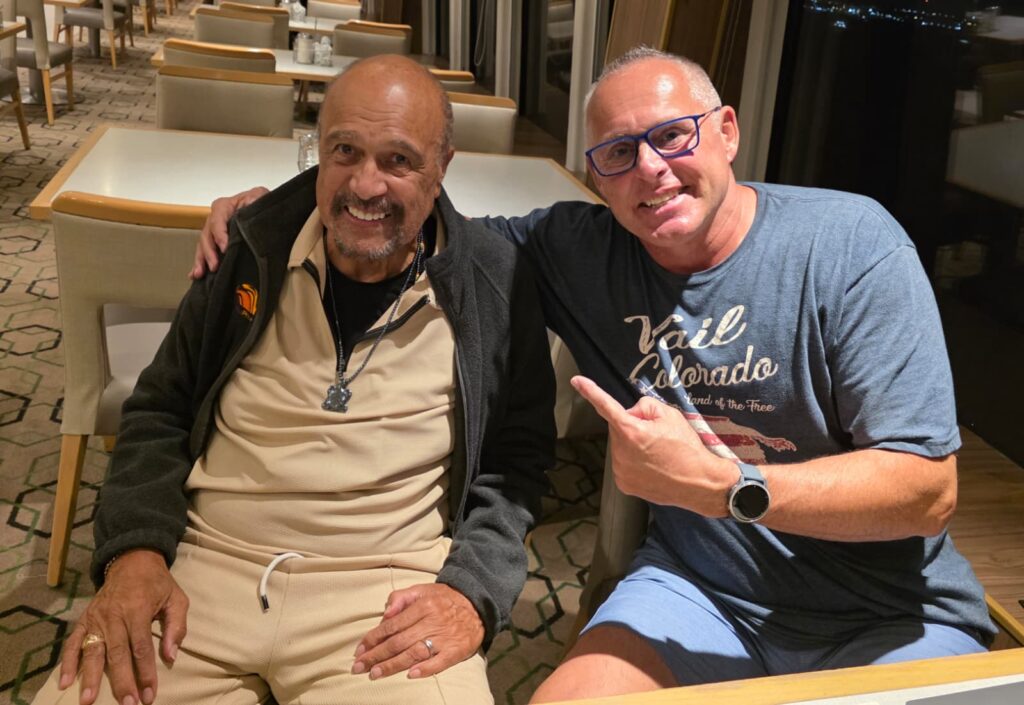
The photo attached to this post was taken in December of 2025. It was taken during a chance meeting between myself and Darryl Hill, a historical figure whom I wasn’t even aware of! Darryl is the “Jackie Robinson of college football.” In 1963 – after being recruited by University of Maryland’s legendary Assistant Coach Lee Corso – Darryl was the first black athlete to be awarded a scholarship and play south of the Mason Dixon line for a major southern university. At that time, black athletes played in northern universities or HBCUs. Darryl’s joining the Maryland football program was such a landmark event, that Clemson University threatened to leave the Atlantic Coast Conference (ACC) if Maryland had him in the roster. South Carolina vowed not to play Maryland in their home stadium. When Maryland traveled to Clemson to play their away game, Darryl’s mother was initially denied entry into the “whites only” stadium, until a good human by the name of Robert C. Edwards intervened, performed an act of inclusion, and escorted Mrs. Hill to his private box to watch the game. Edwards was the then-Clemson president. Again – this all occurred just six short years before I was born! My chance meeting with Darryl and his lovely wife Cheryle, and being able to share some dinners with and learn from them, was one of highlights of my 2025, as well as a reminder of our country’s not-too-distant history.
Above, I mention that friends of my youth have children that are just the second generation of working adults since the Civil Rights Act was passed. I say that because I’m a firm believer that economics has and will continue to have one of the most meaningful impacts on creating a more equal society. When I was young, I would hear ignorant adults make comments associated to black rights such as “slavery ended 200 years ago – get over it.” The reality is that it will take several generations to matriculate through educational systems and good careers until blacks in the United States can enjoy the same economic freedoms that others have enjoyed for hundreds of years. Thankfully, that trend began in the 1970s and through the last several decades, the playing field has gotten more level. I didn’t say level, but much more level. And for what it’s worth, the economic principle of education and solid careers and resultant incomes apply to all young Americans today, regardless of race. The rising cost of living is creating “haves” and the “have nots.” If you are in your 20’s today, it has become increasingly difficult to get ahead. Rents, the cost of housing, and prices in general have spiraled higher far quicker than incomes. I’m a firm believer that education and gainful careers are the only way for young people to have a chance to level that playing field. Career fields in STEM, for example (Science, Technology, Engineering, and Math), can elevate salaries to six figures quickly. Prosperous and life-elevating careers are certainly not limited to that space, yet the same principle applies.
Polarizing figure Charlie Kirk made the comment that DEI hiring causes minorities to take “white jobs” (and no, he wasn’t taken out of context). As a white person, I found that remark highly offensive and frankly, completely off mark. I was in the recruitment industry for close to 20 years, where my firm supported hundreds of external customers with their hiring needs. Not once – not once – did I ever see a job description from a customer that was marked “white job.” What the heck does that even mean (rhetorical question)? My post is not to defend or criticize DEI hiring, nor to offend sensitivities. Why do I wade into this area? To make this point: America is not a “zero sum game.” There is so much opportunity in this country to get ahead. What we have witnessed in this country is a larger pie for all Americans to enjoy. In the year that I was born, Gross Domestic Product (GDP) – the measure of all final goods and services produced within our borders – was $1.04 trillion (~$5 trillion adjusted for 2020’s inflation). U.S. GDP in 2025 has now approached $30 trillion! United States Marine and four-star General James Mattis reiterated that “Our Union is Our Strength.” There is enough to go around for all of us. We need to start acting like neighbors who are all in the same rising ship, and support each other as such, as opposed to acting as if we’re all competing for a limited amount of life rafts.
On this 40th observance of Martin Luther King, Jr. Day I encourage anyone reading this post to spend thirty minutes researching American history. Google the Civil Rights Act. Google “Heart of Atlanta Motel vs the United States.” Google the “top 10 civil rights milestones” or “black income versus white.”
Thankfully, a significant amount of forward progress has been made in our country. There is still more to be done (in many areas – we are far from the best version of our collective selves). Let’s all count our blessings and be part of a United States of America. One in which we celebrate each other’s wins and not view someone else’s win as your loss. Lift each other up.
And in closing, never forget MLK Jr.’s famous quote: “The ultimate measure of a man is not where he stands in moments of comfort and convenience, but where he stands at times of challenge and controversy.” Combine that ethos with Ghandi’s “Be the change that you want to see in the world,” and we will, indeed, be the United States. A nation where there is the abundance of the American Dream for each and every one of us.